


KCC delivered solid third-quarter results, with fourth-quarter results expected to reach a record high
Source:Beyond Shipping
2026-10-29
On October 27, Norwegian shipping company Torvald Klaveness’s Klaveness Combination Carriers ASA (hereinafter “KCC” or “the Company”) released its third-quarter 2026 results.
Specifically, in Q3 2026, KCC achieved net operating revenue of US$60.191 million, up 15.5% year on year; EBITDA reached US$40.372 million, up 4.8% year on year; and net profit reached US$23.597 million, up 13.7% year on year.
In Q3, the CABU fleet’s average daily TCE was US$34,499, about 1.4 times that of MR tankers. The CLEANBU fleet’s average daily TCE was US$38,164, about 1.1 times that of standard LR1 tankers.
In short, KCC’s combination carriers “outperformed” the market in Q3.
In the first three quarters of 2026, KCC achieved net operating revenue of US$160 million, up 51.1% year on year; EBITDA reached US$110 million, up 89.3% year on year; and net profit reached US$59.944 million, up 160.0% year on year.
In the first three quarters, the CABU fleet’s average daily TCE was US$32,909, and the CLEANBU fleet’s average daily TCE was US$39,110.
KCC CEO Engebret Dahm said, “KCC has delivered another solid quarter, supported by a strong market, improved trading efficiency and increased earning days following the delivery of the third and final CABU newbuilding. With the tanker market booming and dry bulk earnings solid, KCC is positioned to enter the fourth quarter with a record TCE earnings outlook. While geopolitical turmoil continues to drive market volatility, KCC remains focused on further strengthening the resilience of its business.”
In particular, according to follow-up reporting by Shippingjie.com, KCC’s CABU combination carrier “Banastar” (IMO 9228045, 72,562 dwt, built 2001) has been included on the “violating vessels” list issued by Iran’s Persian Gulf Strait Authority (PGSA).
KCC said that for Q4 2026, it expects the CABU fleet’s TCE to be approximately US$43,000–48,000/day and the CLEANBU fleet’s TCE to be approximately US$49,100–56,200/day. Annual contract negotiations are underway, and KCC expects to conclude solid contracts in 2026, further strengthening the Company’s resilience amid medium-term market uncertainty.
KCC’s CEO pointed out, “Many would say that with wars and conflicts still ongoing, shipping and KCC are currently making money for all the wrong reasons. There is of course some truth to that.”
He stressed that for a shipowner, the strategy is to go with the trend. KCC is redeploying its CLEANBU fleet into the product tanker market in response to higher refining activity and longer voyages brought about by geopolitical turmoil, and expects fourth-quarter earnings to reach a record high.
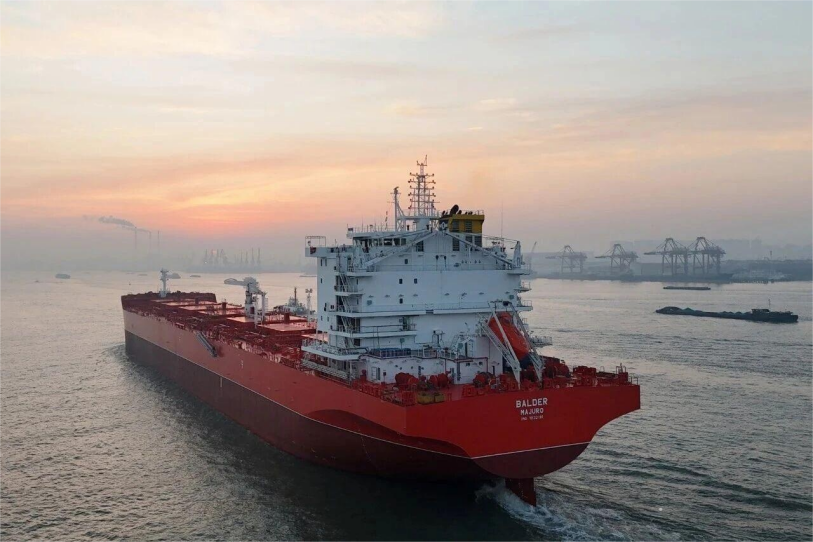
Currently, KCC’s combination carrier fleet consists of 11 CABU vessels and 8 CLEANBU vessels. CABU combination carriers are combination vessels mainly transporting caustic soda solution and dry bulk cargo, with 72,500–80,500 dwt. CLEANBU combination carriers are 82,500 dwt; put simply, they are both LR1 tankers and Kamsarmax dry bulk carriers.
Hot News