


World’s first LNG carrier equipped with two sets of hard wing sails makes its debut
Source:
2026-09-14
According to an official announcement from Mitsui O.S.K. Lines (MOL) and multiple media reports, on September 10, MOL held a grand naming ceremony at Hanwha Ocean’s Geoje shipyard in South Korea to name the world’s first LNG carrier equipped with two “Wind Challenger” hard-sail wind-assisted propulsion systems.
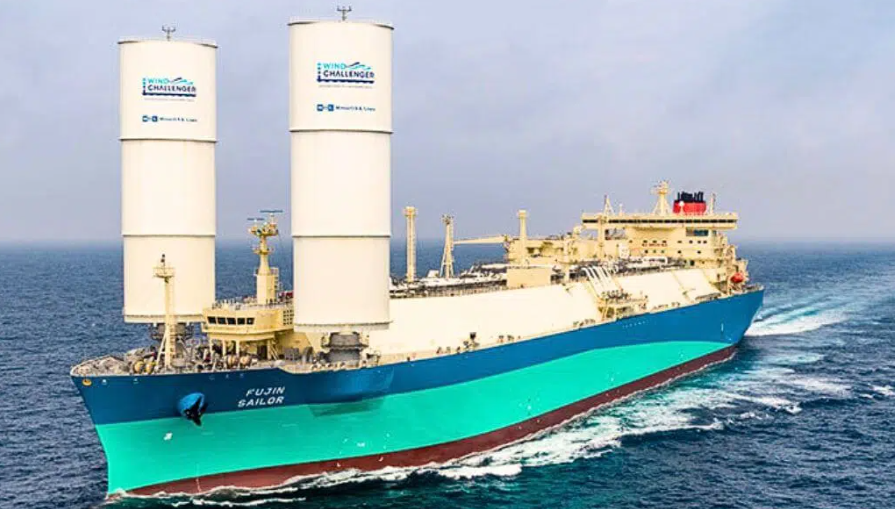
The vessel was officially named “FUJIN SAILOR,” with Ms. Molly T. Laegeler, President of Chevron Supply and Trading, serving as godmother and presiding over the naming ceremony. The “FUJIN SAILOR” will be delivered at the end of September 2026 and will enter service for Chevron under a long-term charter. The vessel will be managed by MOL Global Ship Management Pte. Ltd., a wholly owned subsidiary of MOL.
The “FUJIN SAILOR” has set three world firsts: it is the world’s first LNG carrier equipped with a wind-assisted propulsion system, the world’s first vessel of any type to install two Wind Challenger systems, and the fourth of 11 MOL Group vessels that are equipped or will be equipped with the system.
Makoto Inomoto, MOL’s Managing Executive Officer responsible for LNG and ethane business, said: “The ‘FUJIN SAILOR’ plays a vital role in ensuring a stable energy supply while helping reduce the environmental impact of LNG shipping. By equipping the vessel with wind-assisted propulsion technology, it becomes a new milestone in the innovative development of LNG carriers.”
Molly T. Laegeler, President of Chevron Supply and Trading, said: “Reliable energy supply depends on trusted partnerships and continuous innovation. The ‘FUJIN SAILOR’ brings together the efforts of many parties and demonstrates how practical innovation can help reduce the carbon intensity of LNG transportation while supporting global energy security and reliable delivery.”
The “FUJIN SAILOR” has an overall length of 294.9 meters and a breadth of 46.4 meters. It is equipped with membrane-type cargo tanks with a capacity of 174,000 cubic meters, and its main engine is an ME-GA engine. Its environmentally friendly emissions-reduction features include two Wind Challenger hard sail systems, an air lubrication system, and a shaft generator. The Wind Challenger system was jointly developed by MOL and Oshima Shipbuilding and uses a retractable hard sail design that utilizes wind energy as additional propulsion. Each sail is approximately 15 meters wide and can reach a maximum height of 49 meters (three-stage telescopic). It is made of fiber-reinforced plastic (FRP), combining strength and lightweight construction.
According to MOL’s estimates, an LNG carrier equipped with two Wind Challenger systems can reduce fuel consumption by up to 12% per voyage, depending on weather and sea conditions.
Hot News