


The research vessel Dongfanghong 2 has completed its refit and can serve for another 30 years.
Source:
2026-07-30
According to CCTV News, today (the 29th), the comprehensive ocean scientific research and training vessel Dongfanghong 2 completed its refit and upgrade and was officially delivered in Qingdao, Shandong Province.
The vessel had previously served safely for 27 years, accumulating over 600,000 nautical miles of navigation and successfully completing 160 major scientific research voyages. This renovation and upgrade has achieved comprehensive improvements in six dimensions, including ship control and propulsion, scientific research system functions, operational space layout, and overall navigational performance.
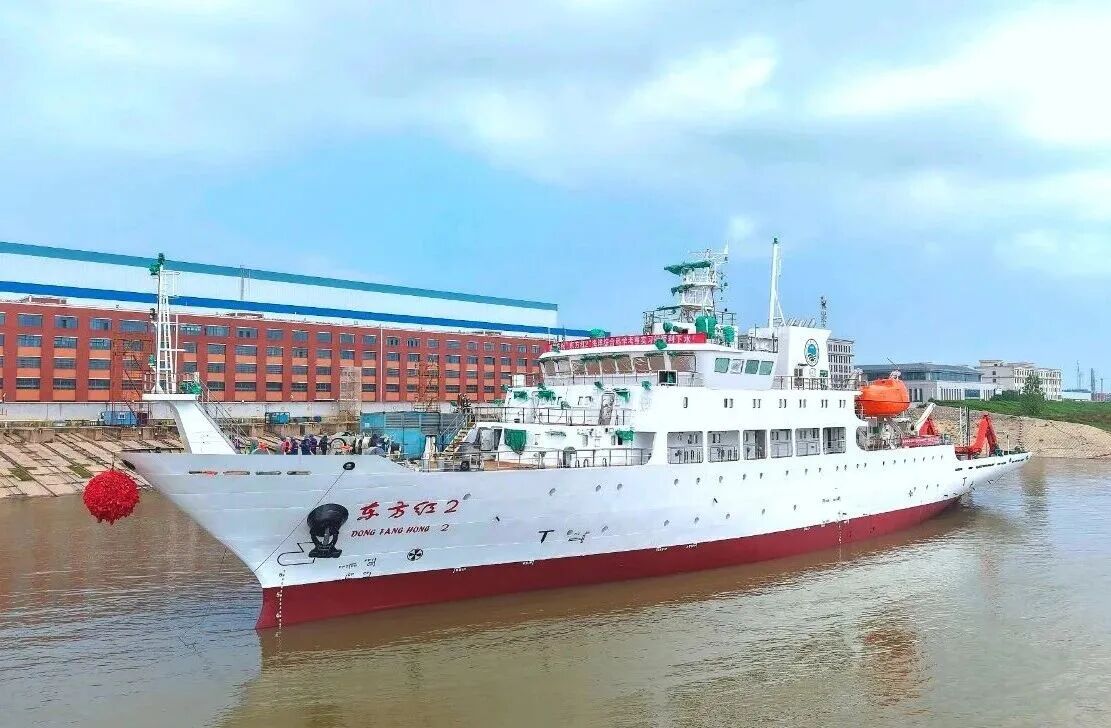
The upgraded vessel is capable of global navigation in unlimited navigation areas, with a range of up to 13,000 nautical miles and an endurance of 60 days. Its operating water depth has been increased from the original 6,000 meters to 10,000 meters, enabling more effective support for operations in all sea areas. It can also simultaneously conduct multidisciplinary "one-stop comprehensive scientific research" covering hydrology, meteorology, physics, chemistry, geology, biology, and geophysics. It is expected to serve stably for another 30 years.
According to Hubei Daily, citing sources from Wuchang Shipbuilding under China State Shipbuilding Corporation (CSSC), the refit is not a simple renovation but a systematic upgrade centered on the goals of "restoring functions, expanding capabilities, and optimizing performance." It involves upgrades to ship control and propulsion systems, scientific research systems, operational space, navigational performance, user experience, and service life, striving to endow an old vessel with future‑oriented scientific research capabilities.
Tong Yao, project manager of the Dongfanghong 2 at Wuchang Shipbuilding, said: "We have added a dynamic positioning system to this vessel, which allows the ship to maintain a fixed position at sea for extended periods to support our scientific experiments. In addition, it also has track planning capabilities, enabling fully automatic navigation from point A to point B, which reduces the operational difficulty for the crew at sea."
During the refit, the team used 3D digital modeling technology to repeatedly optimize the limited cabin space, ensuring the living needs of 160 personnel while completing the re‑layout of modern scientific research equipment and specialized laboratories. Through vibration and noise reduction techniques and precision measurement and calibration, they significantly reduced the vessel's operational vibration and underwater radiated noise, improving the accuracy of marine environmental observations and data collection. At the same time, they solved industry challenges such as the compatibility and adaptation between the old hull design and new scientific research equipment.
Tong Yao further explained that after the optimization, the laboratory will support a greater variety of experimental types per voyage, and the layout has also been significantly adjusted. For instance, the aft deck is now directly accessible from the lab, which will improve the efficiency of sampling operations for researchers on board.
In addition, the refit also enhanced the lifting capacity of the onboard large crane to accommodate larger scientific equipment. The boom has been changed to a folding type, which effectively lowers the ship's center of gravity and improves navigation stability.
The Dongfanghong 2 is an important member of China's Dongfanghong series of comprehensive ocean scientific research and training vessels. It is affiliated with the Ocean University of China and was put into service in January 1996. Over 27 years, it has accumulated over 600,000 nautical miles of navigation, equivalent to circling the Earth 28 times; completed 160 major national scientific research voyages, reaching the Northwest Pacific, the Indian Ocean, and the Mariana Trench; and has taken more than 20,000 students majoring in marine‑related disciplines to sea, giving them their first real understanding of tides, currents, and the deep ocean.
Hot News