


Maersk Ramps Up Terminal Investment in Nigeria
Source:
2026-09-11
This week, Nigerian government officials signed a memorandum of understanding with Maersk-owned APM Terminals (APMT) during a visit to Denmark to develop a new greenfield container terminal in Badagry, on the southwestern outskirts of Lagos. The two sides will hold exclusive negotiations on the project’s development. The move is seen as a signal that Nigeria is accelerating efforts to address its deep-water terminal shortfall against the backdrop of rapid container trade growth and intensifying regional port competition.
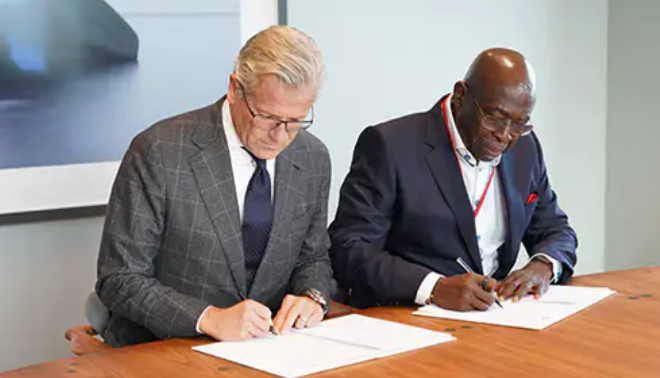
APMT said the deep-water capability of Badagry Port is transformative, will strengthen Nigeria’s position as West Africa’s leading gateway port, and will create significant new transshipment opportunities. If built, the project would allow larger container ships to call at Nigeria, thereby supporting growth, enhancing supply chain resilience and bringing new trade opportunities. APMT said it is committed to advancing the Badagry development.
In the Lagos port landscape, Badagry would join three existing major terminals: APMT’s Apapa Container Terminal, CMA CGM’s Lekki Free Port, and the Tin Can Island Container Terminal (TCIT), jointly operated by ZIM, China Merchants and MSC’s Africa Global Logistics.
However, the Badagry project is not a new idea. Shipping analysis firm Alphaliner noted that APMT expressed interest as early as 2012 and led a consortium comprising Orlean Invest, Macquarie, Oando, the Chagoury Group and Terminal Investment Limited to build the greenfield port. The first phase was originally scheduled to begin operations in 2016, including 6,500 meters of quay line and 39 hectares of yard. But it was subsequently shelved for a long time due to sectarian violence in Nigeria, political and economic instability and regional piracy.
At the industry level, the development of the nearby Lekki Port also poses competition. Lekki Port was initially owned by Philippines-based International Container Terminal Services, Inc. (ICTSI), was launched in 2012, only officially began operations in 2023, and has since been acquired by CMA CGM and its financial partner China Merchants. Alphaliner also said MSC plans to develop a new container terminal on Snake Island near Tin Can in Lagos.
But Nigeria’s port development still lags behind its regional neighbors. According to Xeneta’s eeSea liner database, ships on MSC’s flagship AFL service have an average capacity of 17,300 TEU, yet do not call at Nigerian ports; instead, they discharge cargo at MSC-controlled terminals in Tema, Lomé, Abidjan and Kribi. eeSea data shows that the Tin Can Island Container Terminal, in whose operations MSC participates, has a capacity of only 700,000 TEU; Apapa Container Terminal has 1.2 million TEU; and Lekki Free Port has 2 million TEU. Analysts believe that, given Nigeria’s market potential, there is still room to absorb additional terminal capacity.
Igor van den Essen, APMT’s Managing Director for Africa and Europe, said APMT is willing to contribute to Nigeria’s economic growth and its position as a West African trade hub, will continue long-term investment in the Apapa and Onne concession projects, and believes the Badagry greenfield project will ease urban port congestion and open up new opportunities.
Currently, the Badagry project remains in the exclusive negotiation stage, and whether it will actually materialize remains to be seen.
Hot News