


New Study: Competitiveness of Nuclear-Powered Ships in Doubt
Source:
2026-10-29
A new research report released by University College London (UCL) on October 27 shows that nuclear-powered container ships could become economically competitive by 2040, but only if reactor costs fall sharply and global emissions regulation is effectively in place. The study, conducted by the UCL Shipping and Ocean Research Group, is titled *Nuclear Reactors for Merchant Shipping: A Total Cost of Ownership Assessment of a Low-Carbon Pathway*. It finds that without the International Maritime Organization’s (IMO) Net-Zero Framework (NZF), nuclear propulsion cannot compete economically with conventional shipping even under the most favorable reactor cost assumptions.
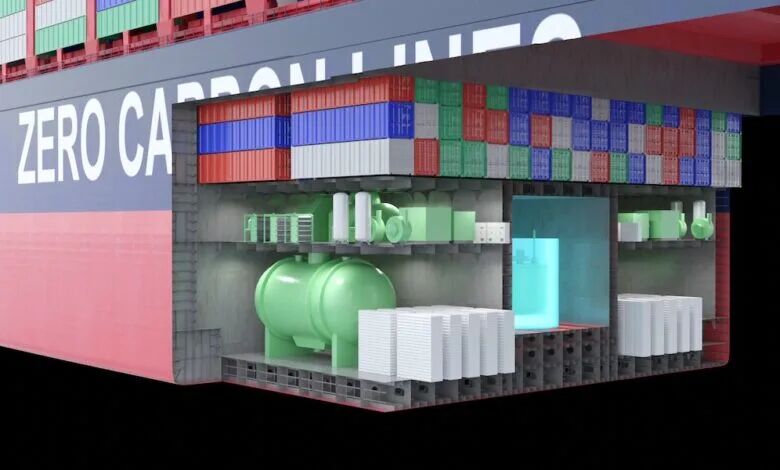
The study examined the total cost of ownership (TCO) of nuclear-powered container ships with capacities of 14,500 to 19,999 TEU and compared them with conventional fuel-powered ships and ammonia dual-fuel ships. It was based on a literature review, five expert interviews, and economic modeling. The modeling covered different reactor costs, ship speeds, and emissions policy scenarios through 2050.
In the model, a conventional container ship costs USD 119.6 million, and an ammonia dual-fuel ship costs USD 148.5 million. The cost of a nuclear-powered equivalent ranges from USD 228 million under optimistic assumptions to USD 582 million when first-of-a-kind reactor technology is used.
Reactor cost is the decisive variable, at roughly USD 2,600 to 12,400 per kilowatt-electric (kWe). The researchers estimate that for nuclear propulsion to be commercially attractive, reactor production costs would need to fall by as much as 80%, a reduction that has not yet been demonstrated.
Under the most favorable assumptions, low-cost nuclear-powered ships would become the lowest-cost option from 2040, but only if the proposed IMO Net-Zero Framework is included, allowing nuclear-powered ships to earn revenue through surplus emissions allowances. Without this framework, no nuclear scenario can beat conventional shipping, and high-cost nuclear configurations will not be able to compete with conventional ships.
The study also rebuts the view that nuclear propulsion can transform container shipping economics by greatly increasing speed. The model shows that at 25 knots, a ship’s annual sailing distance would increase by 32% compared with 14.85 knots, but the installed power required would more than triple, and the resulting increase in reactor cost would exceed the benefits of the capacity gains.
The study notes that even these estimates may overstate the advantages of nuclear propulsion. The model does not include insurance, reactor maintenance, and hull integration costs specific to nuclear-powered ships, and decommissioning costs are also highly uncertain.
In addition, insurance and liability issues are particularly prominent. Current nuclear liability conventions address fixed reactors, not ships crossing international borders.
The researchers argue that the first nuclear-powered merchant ships will likely require bilateral agreements between willing governments before a global regulatory framework can emerge.
The core question is: who will finance expensive first-generation nuclear-powered ships before the economies of scale needed to make the technology competitive are achieved?
Farah Bziker, a researcher in the UCL Shipping and Ocean Research Group, emphasized the uncertainty surrounding the commercial prospects of nuclear-powered shipping. He said: “Nuclear energy can be competitive, but only if reactor costs fall substantially and a global emissions policy exists—and neither is currently in place. How these two factors develop in the coming years will determine whether nuclear has a place in shipping.”
Hot News